
White, black, brown, and yellow are often colors used to describe a race; however, no one is ever truly those exact colors. So let’s get skin deep and explore why stereotypes miss the bigger picture.

Color is defined as “the visual perception of light reflected off objects,” and as light bounces into our eyes, it can create a myriad of different colors. To learn more about how the human eye actually perceives color, Steve Ottmer, a human anatomy teacher at Coronado High School, explained, “We have two types of photoreceptors in our eyes. We have cones that can see color in the day and rods that see at night. Everybody has a different number of rods and cones, but it is more or less the same.”
There are three different types of cones: some to see green, red, and blue. Mr. Ottmer made an example of a piece of blue tape, explaining that he might have more blue cones in his eyes, so we both see the color is blue, but it’s a slightly different shade: “That’s why everybody, more or less, sees the same colors, but the shade and hue are different for everyone.”
To explain the color itself, Jasmin Kuykendall, an art teacher at Coronado High School, talked about how skin tone is dependent on so many different factors. When painting accurate skin tones, colors like blue, purple, and red are used, and the most common mistake artists make is to not utilize all of those colors.

“We get stuck in this stereotype: ‘like, oh, a white person, let me grab tan. But, oh, this person is Indian, so let me grab this brown color,’ but that’s never fully accurate. Pay attention to the light of people,” Kuykendall reminds, “it’s the light in which you see people not actually what their skin tone is.”
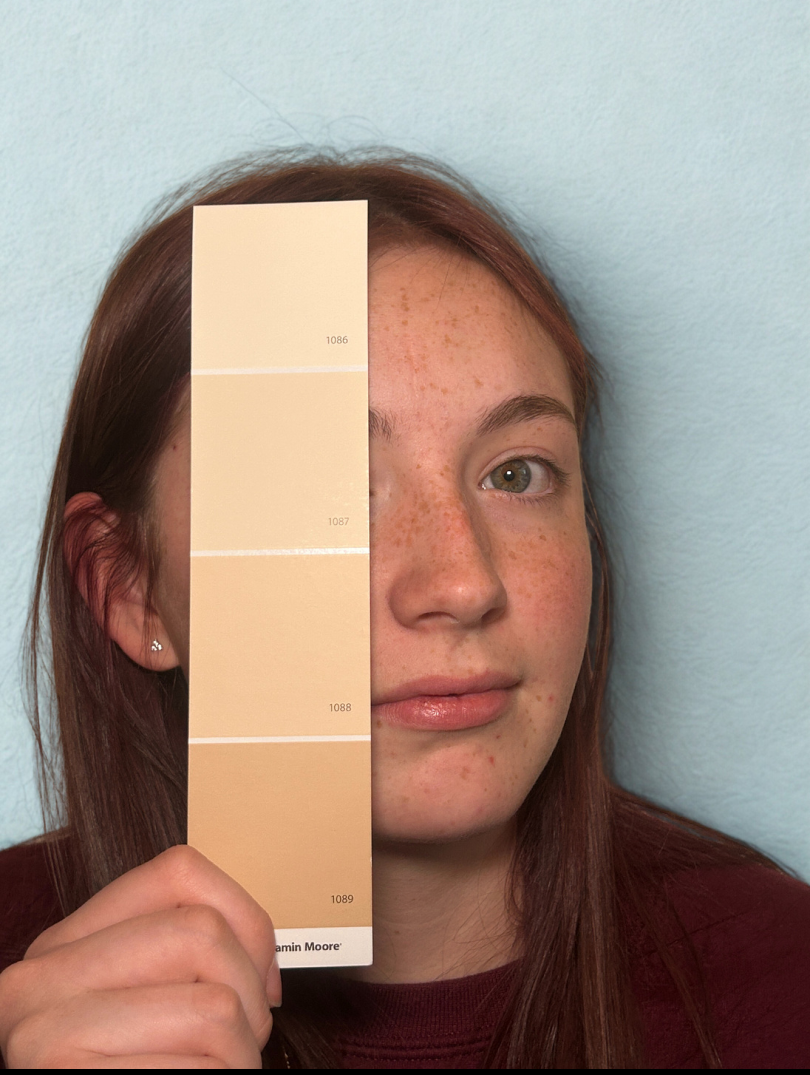
I wanted to run an experiment and see how vast the color spectrum for skin tone is. I offered students at Coronado High School a large variety of paint chips, and tasked them to find the color that matched their skin tone the closest. Most of the students struggled with this, realizing lighting really does change the outcome drastically. Other students were shocked to find their assumed skin tone wasn’t very accurate, or that the paint chip only matched a small part of their arm. Then to show the comparison between their true skin tone and the label they fall under (white, black, brown, or yellow) I had them hold the two paint strips together.
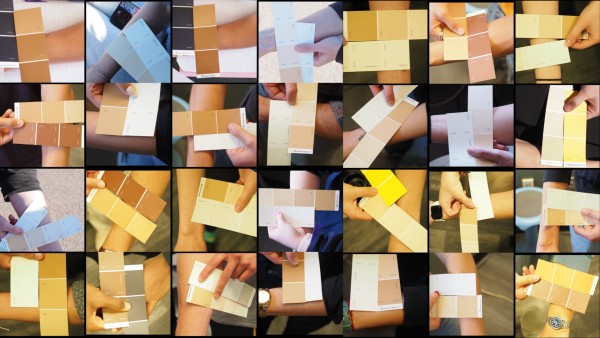
Through this experiment, I, and many of my peers realized the labels are never all-inclusive, and do not define every skin tone underneath it. It’s important to remember there is beauty in everything, and like Kuykendall said, “Pay attention to the light of people,” not just the label they are given.