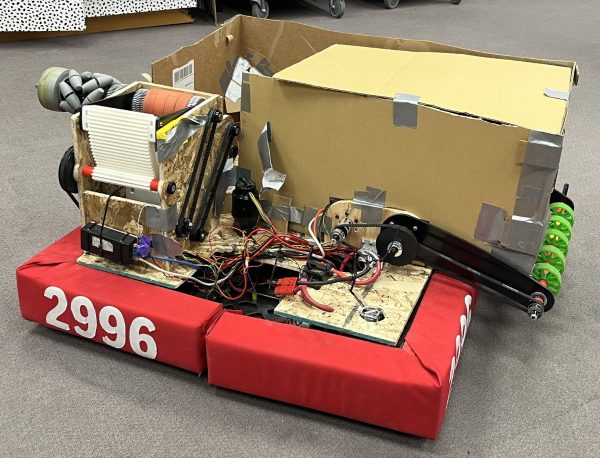
As Coronado’s FRC team, Cougars Gone Wired, heads into the second half of “build season,” the six weeks they’re given to design and build a robot before competing, the team is busy working on a second iteration of their design. Seeing the full machine, it might be hard to believe that a team of high school students designed and built it from scratch, but they’ve put in a lot of work to get there.
The 2026 robotics season started on January 10th, a Saturday, with an event called Kickoff. Students and mentors gathered in the Coronado auditorium in the morning to watch a broadcast together. The live video, watched by teams around the world, revealed the game that FIRST Robotics teams would be designing a robot to play. As soon as the broadcast ended, the team members were in a hurry to get started. The morning was spent reading the extensive game manual, which outlines the specific rules of the game, before getting together in groups to discuss what the robot should do. Kelsey Modaff, Chief Business Officer and student member of the team, shared that these strategy discussions are her favorite part of kickoff because they “require a lot of critical thinking as well as a lot of different perspectives and ideas at once.” Everyone has their own unique ideas and input, shaped by the way they think and their specialty on the team.
These discussions are more than just a way to come up with ideas for the robot; like many aspects of robotics, they help to prepare students for real-world jobs and equip them with valuable communication skills. Another way the team prepares students for a career is by recruiting mentors who have jobs in STEM, like electrical or mechanical engineering. These mentors help the students to think about challenges as if they were professionals, growing team members’ engineering and life skills.
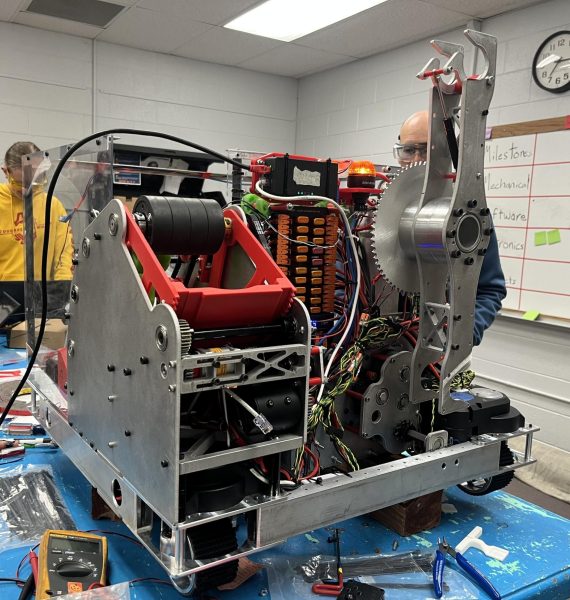
The team spends all day looking over rules and coming up with strategies, eventually coming together at the end of the day to collaborate on one final plan. Next, the team takes that strategy and decides what mechanisms could carry it out the best. Once they have their ideas, prototyping starts. The team creates and tests elements of the robot to see how they would work, and uses that information to make 3D-modeled designs and eventually, the first robot.
Over the course of the six-week season, three robots are built, the first one being made of metal and plastic parts, wood, and cardboard. The final robot will be all metal and plastic, ready to compete with other teams’ unique designs.
If you want to see the robot that the team has put so much work into, it will be competing right on campus in the Main Coronado Gym! We will be hosting the Pikes Peak Regional for the very first time from Thursday, March 5th, to Sunday, March 8th.