


For some students at Coronado High School, learning doesn’t stop when the bell rings. Increasingly, it continues on TikTok feeds, through podcasts, and in Instagram posts that break down anything and everything. As social media has become part of students’ daily routines, it has also emerged as an informal learning space, one that sometimes addresses topics and life skills students feel are not fully covered in the classroom.
Mrs. Lewis, a social studies teacher at Coronado, shared that in her social studies classes, online content often enters academic discussions. She explained that in the U.S government courses, “current events lead to discussions about what students are seeing on social media and the different viewpoints being shared.” When political issues or social movements trend online, students frequently bring them into class. Social media can make these topics feel immediate and personal, while the classroom curriculum typically follows a structured sequence that doesn’t always align with the pace of online conversations.
Some students say digital platforms can provide additional perspectives and explanations. Emelia Lommel, a senior in the top 10% of her class, shared that she has learned practical skills online that are not always emphasized in school. She states that she has “learned a lot of real-world life skills from social media that school doesn’t typically cover, like budgeting, or navigating college applications strategically, and understanding current events in multiple perspectives.” She
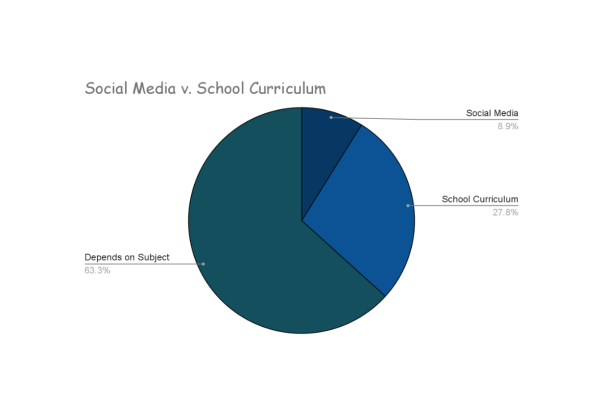
also noted that when she needs a concept explained differently, particularly in math or history, she sometimes turns to social media for a clearer breakdown.
Educators, however, emphasize that social media and classroom instruction serve distinct purposes. Mrs. Lewis noted that one of the key differences is historical context. She states, “Students don’t always have the background to make the different connections that some online content assumes.” In the classroom, lessons are designed to build foundational knowledge over time, allowing students to analyze topics in depth and engage with verified sources. While social media can introduce ideas quickly, formal instruction prioritizes research skills, evidence-based analysis, and long-term understanding.
Social media has also influenced how students communicate. Ms. Dziak, an English and Yearbook teacher, has observed shifts in students’ writing patterns over the years. She explained, “Where we expect full, complex sentences and appropriate punctuation, we often receive sentence fragments that mirror the rapid-fire communication style of social media.” The informality common online can sometimes carry over into academic work.
At the same time, Ms. Dziak acknowledged that social media platforms require users to think carefully about audience and presentation. Students who regularly post online can consider how their content will be interpreted and who will see it, skills that align with rhetorical concepts taught in English classes. This awareness of audience and tone can translate into stronger communication skills when guided appropriately.
Both digital platforms and traditional classrooms offer advantages and limitations. Social media can make complex topics more accessible and expose students to diverse viewpoints. Its visual and interactive formats may increase engagement, particularly for students who benefit from alternative explanations. However, online content often prioritizes speed and attention-grabbing presentation over depth and verification.
Conversely, classroom learning may feel slower by comparison, but it provides structure, accountability, and opportunities for critical reflection. Students learn how to evaluate sources, conduct research, and support claims with evidence, skills that are essential in navigating both academic and digital spaces.
Many students do not view social media as a replacement for school, but as a supplement. As Lommel explained, “High-achieving students rely on social media to look for every possible resource to deepen their understanding. Social media doesn’t replace school but is more about supplementing it.” Her perspective reflects a broader trend, students increasingly combining formal instruction with digital resources to support their learning.
As education continues to evolve alongside technology, the discussion is shifting from whether students should use social media for learning how they can use it responsibly. Teaching media literacy, fact-checking strategies, and critical analysis skills may help bridge the gap between online content and classroom instruction.
While textbooks and lesson plans remain central to education at Coronado, learning for many students now extends beyond school walls, often continuing with a swipe and a scroll.


