
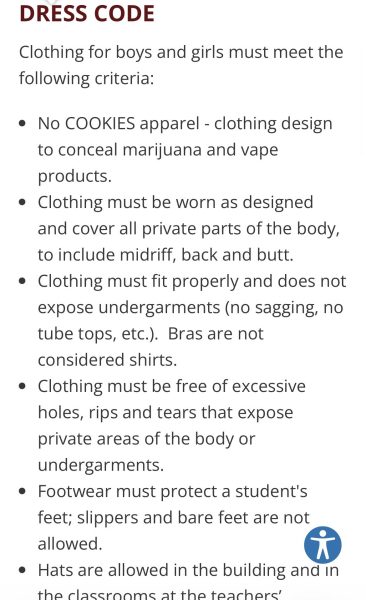
School dress codes are intended to promote respect and focus, but in reality, they often disproportionately target female students. Many of the rules focus on clothing considered “distracting” or “revealing,” such as tank tops, crop tops, short shorts, skirts, or visible bra straps, all items typically worn by girls. This sends the message that girls’ bodies are inherently a distraction, shifting blame to girls instead of emphasizing self-control and respect from others.
Emelia Lommel, Class of 2026, shared, “I have been dress-coded, not as much in high school (a lot more in middle school), but mainly for my length of shorts. It honestly felt frustrating that someone felt the need to tell me that my clothes were inappropriate when it’s so hard to find clothes that fit long legs. It’s not something I can control at all.” This kind of experience shows how unfair and discouraging dress codes can feel, especially when body types vary.
Being dress-coded negatively affects students’ confidence and focus in and out of the classroom. As Lommel further explained, “Dress coding often negatively impacts female students’ confidence…Dress codes can sometimes send the message that a girl’s appearance is more important than her education.” Outside the classroom, it can limit self-expression during sports, dances, or spirit days, forcing girls to think twice about their outfits for fear of being called out.
While the main goal of a dress code is to “prevent interference with education,” as Assistant Principal Mr. Baldwin stated, it’s clear that these policies need to evolve. Dress codes were originally created when society was stricter, with a stronger emphasis on modesty, but times have changed. Schools should now focus on fairness and equality rather than outdated ideas about appearance.
To make dress codes fair for all genders, schools should focus on equality and professionalism rather than appearance. They should also avoid using words like “distracting” or “revealing” and include student voices when creating or updating policies so that all students feel comfortable, respected, and free to express themselves.