
The 2026 Winter Olympics have rolled into Milan this year, and viewers are gearing up to watch all of the classic events such as figure skating, alpine skiing, snowboarding, and many others. But, the International Olympic Committee (IOC) is tacking on a brand new sport to the ever growing list of 116 events. This sport is called ski mountaineering – or ski-mo for short – and ties back to a long history of skiing in Italy and across the world.
So what does ski mountaineering entail? Originally, the events began as a 90 minute race involving a series of ascents and descents, mimicking a form of skiing commonly known as backcountry skiing. Often, the competitors climb between 1500 – 1900 meters over the span of their climbs, and then complete high speed downhill skiing. In addition to that, the athletes are required to transition between their uphill and downhill skis by removing the skins off the bottom of their skis. Skins are a piece of specialized gear that consist of thin pieces of felt that stop the skiers from sliding downhill while they are climbing to the summit.
Hudson Frank, Coronado Class of 2024 and avid backcountry skier, has spent the last three years perfecting his setup. He prefers backcountry skiing because “you get the chance to explore and set your own runs and routes. And, when you find a completely untouched powder run, it’s so much more satisfying because you put the work in to get up there, not just sat on a lift.”
In simple words, it’s skiing without the chairlifts and 5x the suffering.
But, the Olympic competition will run a little differently. Each of the individual races will last approximately 3 minutes, with a 7o meter climb, and then a high speed descent into the finish. There will be a men’s and women’s discipline, and the USA team consists of athletes Cameron Smith and Anna Gibson.
This decision to shorten the distance of these races was made to keep the interest of viewers across the world, given that the normal ski-mo race takes between 1.5 – 2 hours and the Olympic discipline will take just over 3 minutes. But, some would claim that this removes the intensity and endurance that true backcountry skiing and ski mountaineering captures. Oliver Frieling, Class of 2026 and captain of Coronado’s ski team, says that “backcountry skiing is designed to cover ground and get out there,” and the shortened version of this sport may not capture the true grit and determination that this sport stemmed from.
Cameron Smith grew up in Illinois, but began his ski-mo career in 2014, after completing college in Gunnison at Western Colorado University. He now lives and trains in Crested Butte, and has 11 national ski-mo championships under his belt. In an interview with TrainingPeaks, he discusses the challenges that the ski-mo sport entails, mentioning that “its critical to have the muscle capacity to handle intense downhills after arriving at the top of the mountain at your max heart rate.”
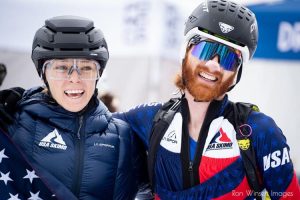
The endurance part of the races are key, and Smith trains laps in Crested Butte with weights on his ankles to mimic the weight he will be managing on the race course. He holds course records for three major ski-mo courses across the nation, and is competing in both the relay and individual section of the Olympics.
On the other side of the team, Gibson hails from Jackson, Wyoming, the home of world-class ski resort Jackson Hole. She began her athletic career running, going as far as the Olympic Trials for the 1500 meter run. She was recruited into skimo by Cameron, and made the cut for Team USA by a massive margin in all three races, securing her a spot next to Smith in this year’s Olympics after only training 6 months for her ski-mo debut. It’s not all that easy though, because Gibson has the experience in high-intensity, endurance training through her pro cross country career and a long history of Nordic skiing. Though she may be remotely new to ski mountaineering specifically, she is far from inexperienced and has trained for years to be in Milan this February.
The Winter Olympics are well known for their high speed, intense sports across the ice and snow. Alpine and downhill skiing, figure skating, and the high speed chase of the luge and bobsled capture viewers’ attention across the globe. Will ski-mo find its spot among the best, or will it be another sport with a short-lived Olympic career?