


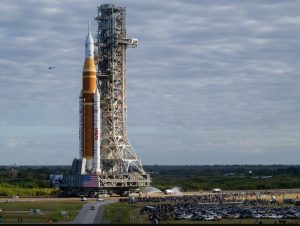
History was made April 1, 2026 as the Artemis II launched from NASA’s Kennedy Space Center in Florida. Commander Reid Wiseman led the small crew of four in the daring ten day mission to the dark side of the moon. Most of the technology used for the mission is new, adding an extra layer of risk to the mission.
For two days, Pilot Victor Glover, tested the systems near Earth before starting the journey to the Moon. If anything were to go wrong, Mission Specialists Christina Koch and Jeremy Hansen were well equipped to solve the issue. Mr. McLean, the Aerospace Engineering teacher ,noted that “Traveling to the Moon also means spending more time in the harsh environment of deep space, where astronauts and spacecraft are exposed to radiation, extreme temperatures, and the inability to quickly return to Earth in case of emergency. These factors together make lunar missions far more challenging and risky than missions closer to home.”
This launch was no small feat as many technical challenges had to be resolved. The first and most obvious, is getting to the Moon and back without running out of fuel. Using the Earth’s gravity, the crew looped around Earth using the momentum to propel them to the Moon. The next problem would be reentry. Due to air friction, the capsule gets extremely hot. The pod is equipped with a heat shield to protect the crew. However, two unforeseen problems did arise: a faulty battery sensor almost caused the launch to be scrubbed, however after a quick diagnostic the mission was able to continue. Later the crews toilet became clogged due to freezing temperature creating an ice blockage.

Artemis II was also fitted with high resolution cameras. According to Joshua Kattelmann, Class of 2027 robotics student, “This is the first time we’re getting high-resolution images that’s not in a satellite. We’re getting good shots of planets and stars.” Lunar phases also impact the quality of the photos; Mrs. Morey, Astronomy teacher, explained, “Moon missions often launch near New Moon because of better illumination. Astronauts were able to take better pictures of Earth because it’s lit up more during the New Moon phase”
Finally, on April 10, the Artemis capsule splashed down in the Pacific Ocean, off the coast of San Diego. With the crew safe on Earth, the Artemis II mission is finished, adding another stepping stone for the long anticipated return to the Moon.


